


 Tiếng Việt
MAIN CONTENTS
REEF REGENERATION PROJECT
Phu Quoc’s Coral Restoration Journey | 2025–2026
Beginning with the establishment of a coral nursery in South Phu Quoc, OnBird’s Reef Regeneration Project has gradually expanded its coral propagation and transplantation efforts across natural reefs in both northern and southern Phu Quoc.
Project Milestones
- April 2025 | SOUTH PHU QUOC – THE BEGINNING: Establishing OnBird’s coral nursery to cultivate and propagate reef-building coral species.
- October 2025 | NORTH PHU QUOC – FIRST TRANSPLANTATION: Launching the first coral transplantation campaign at Coral Jungle Reef, within an approximately 500 m² pilot area.
- April 2026 | SOUTH PHU QUOC – EXPANSION: Extending restoration efforts to four natural coral reefs using nursery-grown coral colonies.
- October 2026 | CORAL JUNGLE REEF – ONE-YEAR ASSESSMENT: Monitoring coral growth and early ecological changes to inform the next stages of restoration.
This report focuses on the first year of coral restoration at Coral Jungle Reef, from October 2025 to October 2026.
Regenerative – Regeneration Is the Future.
One Year of Coral Regeneration: Signs of Life Return to Coral Jungle Reef
Reef Regeneration Project | Field Update: November 15, 2026
Once among Phu Quoc’s most vibrant coral reefs, Coral Jungle Reef in the island’s northern waters suffered severe damage during the global mass coral bleaching event of summer 2024. Large sections of branching corals declined, taking with them the complex underwater habitats that shelter countless small marine organisms.
In response, OnBird, working alongside marine biology specialists, began a long-term effort to help restore the reef’s living structure and marine biodiversity.
On October 22, 2025, our team launched the first coral transplantation campaign across an approximately 500 m² pilot area, combining small-fragment and large-fragment transplantation techniques.
Eight reef-building coral species were prioritized for propagation and restoration, including Cherry Blossom Coral, Staghorn Coral, Cauliflower Coral, and Finger Coral. But transplantation is only the beginning. Our field team continues to monitor how the coral colonies attach to natural substrates, develop living tissue, and respond to threats such as coral-eating Drupella snails. One year later, field observations have revealed encouraging signs of growth, although the journey toward reef recovery remains a long one.
From Small Fragments to Growing Coral Colonies
According to OnBird’s field monitoring records, dozens of Cherry Blossom Coral (Acropora rosaria) colonies are developing across the transplantation sites.
Staghorn Coral colonies have also shown encouraging growth. With their branching structures, these reef-building corals can gradually create the sheltered spaces that small fish and other marine organisms need to feed, hide, and survive.
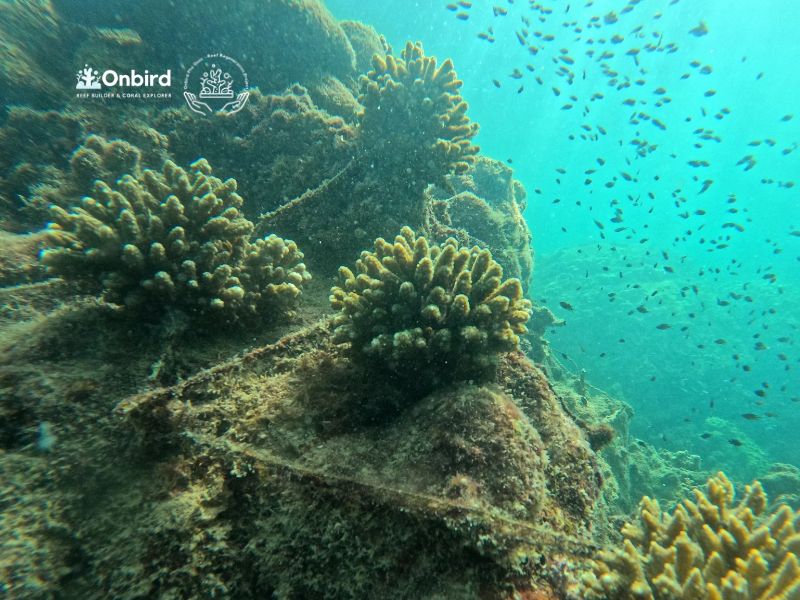
One particularly meaningful result involves Cauliflower Coral (Pocillopora damicornis).
After approximately one year of growth from initially transplanted fragments, our team recorded 13 Cauliflower Coral colonies measuring between 10 and 30 cm in diameter. Once a prominent coral species at Coral Jungle Reef, Pocillopora damicornis was severely affected by the 2024 bleaching event and had almost disappeared from the area. The development of these 13 colonies represents an important step in our effort to re-establish this species at Coral Jungle Reef.
However, the successful development of individual colonies does not mean that the entire reef has recovered.
When Small Marine Creatures Find Shelter Again
Coral restoration is about more than growing coral.
During recent monitoring visits, our team observed schools of small reef fish swimming around the living colonies. Tiny crabs were also seen sheltering among the dense branches of Cauliflower Coral.
These observations offer a glimpse into the ecological importance of branching corals. Their intricate structures create narrow spaces where juvenile fish, small crustaceans, and other marine organisms can seek refuge. Some coral-associated crabs are also known to form beneficial relationships with their coral hosts. While the coral provides shelter, certain crab species can help defend the colony against coral predators, including crown-of-thorns starfish and coral-eating snails.
For OnBird, this is a reminder that the purpose of regeneration is not simply to increase the number of transplanted coral colonies. It is to help rebuild the habitats and ecological relationships that make a reef a living ecosystem.
Large-Fragment Transplants Begin to Establish Themselves
Alongside small-fragment transplantation, OnBird has continued to monitor 11 large-fragment coral colonies transplanted in May 2026.
Recent observations indicate that these colonies are becoming more firmly established on the natural reef substrate, with early signs of attachment at their bases. They remain secured with metal wire to maintain stability during this critical stage. Under suitable water-clarity conditions, the colonies can be observed from the surface at depths of approximately 4 metres. Although these are promising developments, stronger attachment does not mean the corals are free from risk. Regular monitoring remains essential to assess colony health, attachment points, securing materials, and potential threats from coral predators.
Looking Ahead: Expanding Regeneration into Shallower Waters
Other reef-building coral species at the restoration sites have also shown encouraging development in OnBird’s field observations.
Building on these early results, our team is considering the next stage of transplantation in shallower reef areas, at depths of approximately 1.5–2 metres.
The proposed approach involves carefully propagating new fragments from selected colonies that have already established themselves at the restoration sites. This next phase remains under consideration and will depend on the health of potential donor colonies, local environmental conditions, and our capacity for continued monitoring. Our objective is not simply to transplant more fragments, but to gradually expand the reef’s living structure and the habitats it can support.
One Year Is Only the Beginning
One year is not enough to declare Coral Jungle Reef fully restored.
Yet the growth of transplanted colonies, the small fish gathering around them, and the gradual establishment of new coral structures give our team meaningful reasons to continue.
At OnBird, we believe that regeneration is not a promise of instant recovery. It is a long-term commitment to observation, care, and working with nature.
Each growing coral colony represents another small step in that journey. And each step brings us closer to a future where Phu Quoc’s coral reefs can once again support the rich marine life that makes them extraordinary.
Explore our ongoing Reef Regeneration Project and follow the journey of coral restoration in Phu Quoc.