

Cham Island (Cù Lao Chàm), part of Tan Hiep Island Commune in Hoi An City, Quang Nam Province, lies approximately 15 km offshore from Cua Dai Beach. The island group consists of eight main islands: Hon Lao, Hon Dai, Hon Mo, Hon Kho Me, Hon Kho Con, Hon La, Hon Tai, and Hon Ong.
Beyond its distinctive cultural and historical heritage, Cham Island is renowned for its diverse natural environment and relatively pristine landscapes. The islands support a remarkable range of ecosystems representing estuarine, coastal, and marine environments, with a high diversity of species and biological communities extending from the forest to the open sea.
On land, Cham Island is home to a rich variety of flora and fauna, including the rare edible-nest swiftlet and numerous species of wild animals. Beneath the sea, rocky outcrops and coral reefs create vibrant underwater landscapes, supporting a remarkable diversity of tropical fish and marine life.
According to the island management authorities, the special-use forest within the Cham Islands World Biosphere Reserve contains 499 plant species belonging to 352 genera and 115 families, representing five of the six major groups of vascular plants found in Vietnam. Surveys conducted at elevations below 100 metres have also recorded more than 288 species of medicinal plants growing among forests of mature trees such as mật gõ, green ironwood, dầu lôn, chò nâu, huỳnh, and red litsea. Other rare plant species, including velvet orchids and agarwood, can also be found in the area.
Within the core zone of the biosphere reserve, approximately 311 hectares of coral reefs have been recorded, comprising around 300 coral species, with soft corals being particularly dominant. Average coral reef coverage is approximately 41%. The area also contains around 50 hectares of seagrass beds representing five characteristic species, with average coverage ranging from 15% to 25%. In addition, the marine ecosystem supports 76 species of seaweed, more than 270 fish species, 97 mollusc species, and 11 species of echinoderms.
The buffer zone of the biosphere reserve is largely covered by nipa palms and other mangrove vegetation, including mangrove species such as Rhizophora apiculata, Avicennia, and other coastal plants distributed along rivers, sandbanks, mudflats, and coastal areas.
These mangrove and nipa palm ecosystems play an important role as a natural gateway for regulating water quality before it reaches the marine ecosystems surrounding Cham Island. They help filter water, provide nursery habitats for juvenile marine species, and create distinctive wetland landscapes closely connected with traditional local livelihoods and communities.
Visitors to Cham Island can experience the fresh atmosphere of the sea, walk along sandy beaches and swim in clear blue waters, and discover the everyday life of local fishing communities. Popular landmarks include Huong Beach, Lang Beach, Hang Ba Cave, the marine anchorage, and Hai Tang Pagoda. Visitors can also explore colorful coral reefs, hike through the island’s forested hills, join local cultural activities, and enjoy regional specialties such as stone crab, sea cucumber, spiny shells, and aromatic sea snails.
With its outstanding natural and cultural values, Cham Island was recognized by UNESCO as a World Biosphere Reserve on 26 May 2009.
Tourism to Cham Island has grown significantly since its recognition as a biosphere reserve. According to reports from the Cham Islands Biosphere Reserve management authorities, the destination received only several thousand visitors annually in 2009, but this number had increased to approximately 176,000 visitors by 2013. During the first four months of 2014 alone, more than 40,000 visitors travelled to Cham Island, with peak days seeing approximately 2,000–3,000 visitors.
Discover Cham Island Underwater with OnBird
For travelers who want to experience Cham Island beyond the usual sightseeing routes, OnBird offers a professional small-group snorkeling experience designed around the island’s marine environment.
Rather than simply following a conventional island-hopping itinerary, OnBird’s snorkeling experience focuses on exploring coral reefs and marine habitats in a more intimate setting, with a limited number of guests per group. This allows participants to spend more time in the water and observe the underwater environment with greater attention and flexibility.


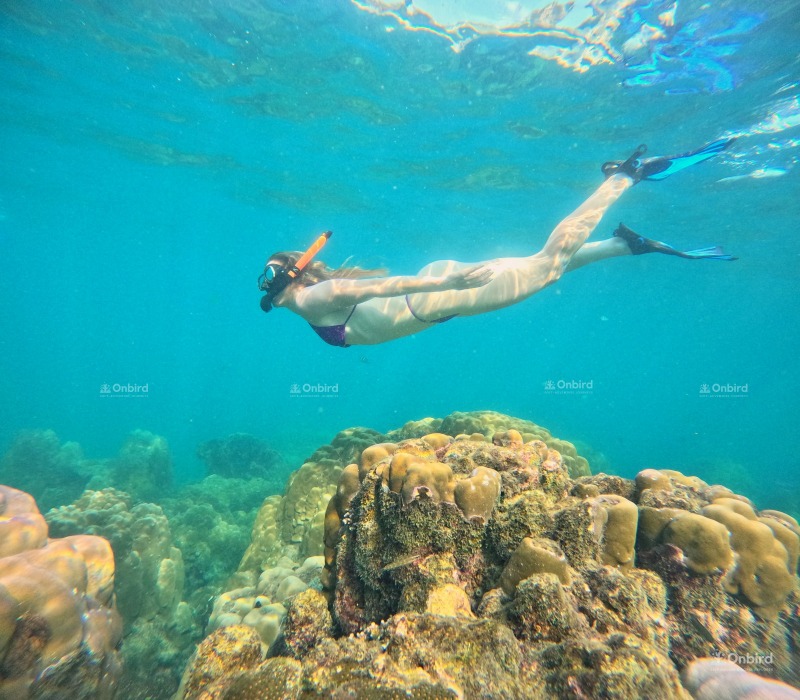

The experience is designed for travelers interested in quality snorkeling, coral reef observation, and marine discovery, while placing emphasis on responsible interaction with the reef environment. Depending on sea conditions, water visibility, tides, and other environmental factors, the snorkeling locations may be adjusted to identify the most suitable areas for the day’s conditions.
With Cham Island’s combination of coral reefs, seagrass habitats, rocky shores, tropical fish, and surrounding island landscapes, OnBird’s small-group snorkeling experience provides a different way to discover this UNESCO Biosphere Reserve — from the perspective of the sea rather than simply from the shore.