


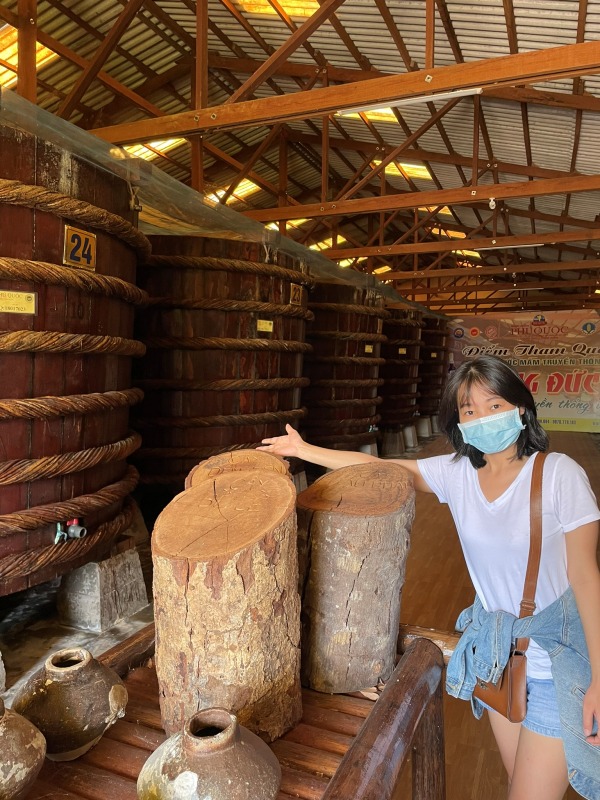
There’s a particular scent that drifts through certain corners of Phu Quoc. Sharp, salty, alive. It comes from rows of tall wooden barrels, bound with rattan rope, where tiny silver anchovies are slowly turning into something Vietnamese families have treasured for generations: nuoc mam, traditional fish sauce.
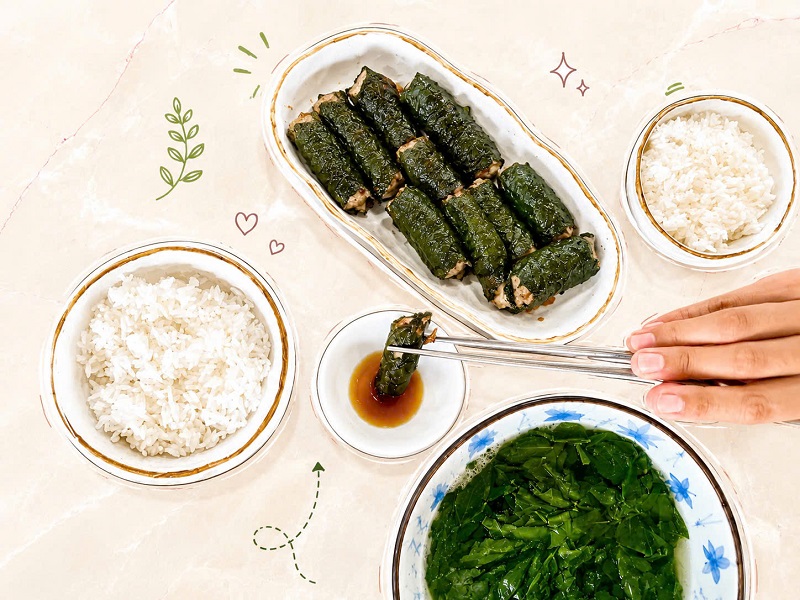
If you’ve eaten Vietnamese food, you’ve already tasted it. Fish sauce is the quiet backbone of the cuisine, in the cooking, in the seasoning, in the little dipping bowl beside almost every meal. And Phu Quoc happens to make some of the finest in the world.
Here’s why it’s worth seeing while you’re on the island, what to look for when you buy, and how to get a bottle safely home.
MAIN CONTENTS
Just two ingredients – and a great deal of patience
Real nuoc mam is almost startlingly simple. Fish and salt. That’s it. No added protein, no colouring, no artificial flavour.
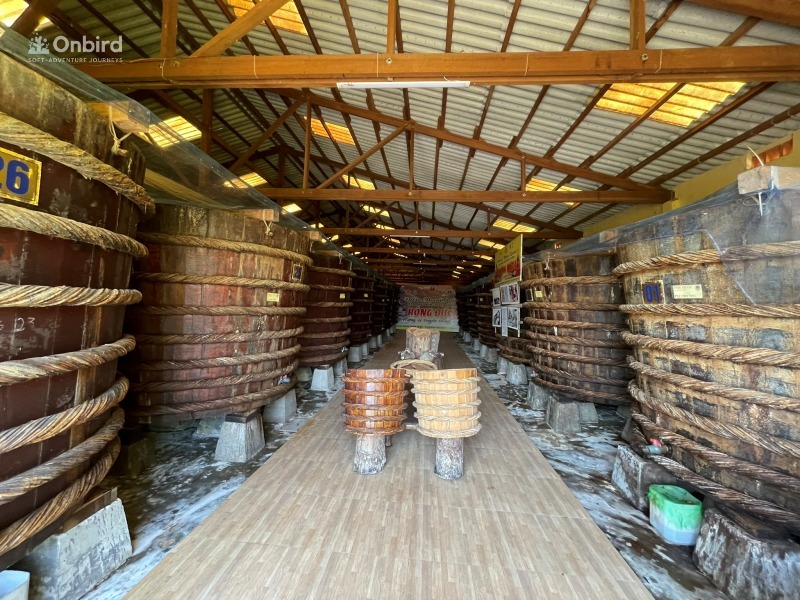
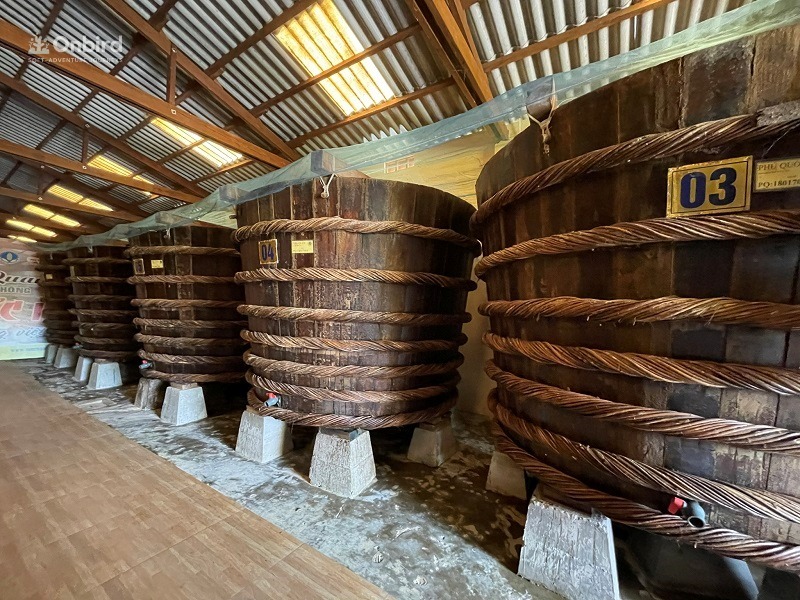
The magic is in the waiting. Fresh anchovies, never frozen, are layered into large wooden vats with a generous amount of sea salt, then left to ferment for roughly nine to fifteen months. As it matures, the proteins in the fish break down naturally into amino acids, and that slow chemistry is what creates the deep, savoury flavour. When the sauce is fully “ripe,” the first liquid drawn off is the purest, most prized grade. The fish-to-salt ratio, the kind of wood used for the barrels, the timing: these are recipes handed down through families, often closely guarded.
One detail to know before you shop: fish sauce ages a little like fine wine. The longer it ferments, the deeper and more nutritious it becomes. Its protein content is measured in degrees of nitrogen (you’ll see a number like “40 N” on the label), and a long-fermented traditional sauce can reach a protein level far above the everyday range. Higher number, richer flavour.
More care than you’d ever guess
What looks simple hides an obsessive attention to detail.
Take the salt. It isn’t just any salt – traditional makers favour sea salt harvested at the start of autumn, when the grains are at their driest and cleanest, white and even with sharp edges. And here’s the part that surprises most people: after it’s bought, the salt is often stored for at least three months before use, to let its bitterness and harsh edge mellow away. Curing fish hasn’t even begun, and already there’s a season of waiting.
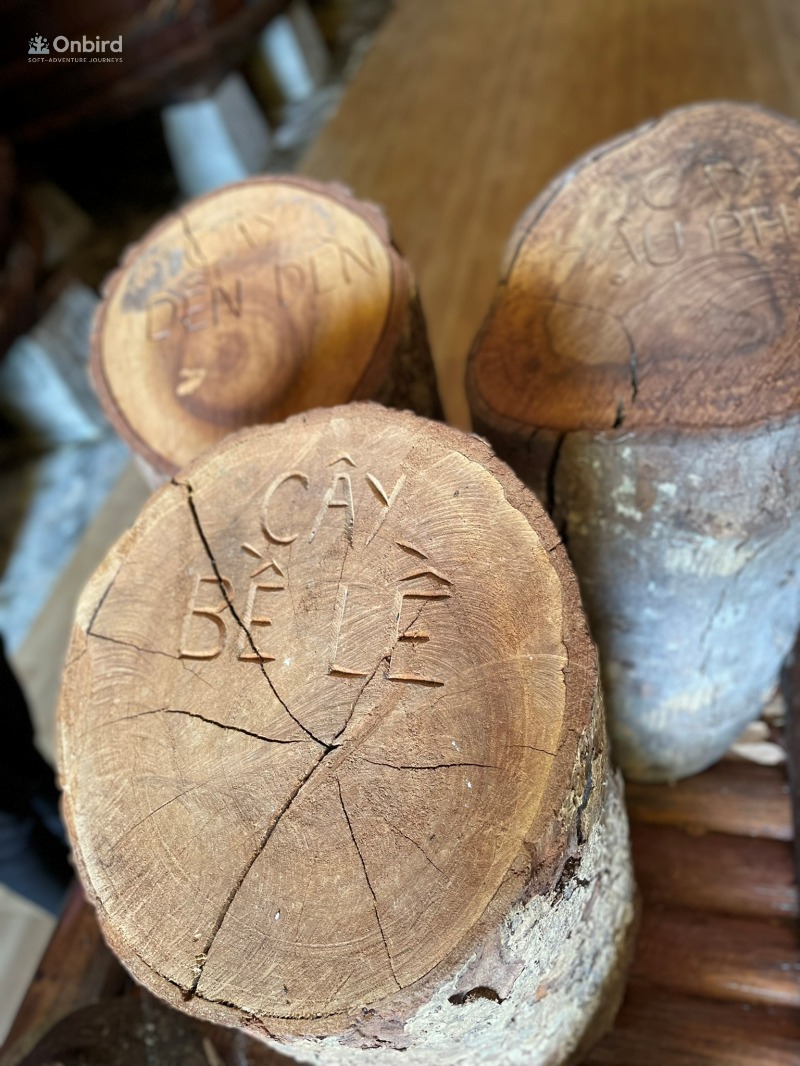
Then the barrels. The classic ones are made of litsea wood, bound with rattan, and sealed at the seams with tree bark, raised off the ground, and big enough to hold many tons of fish at once. A single well-made barrel can serve for decades. None of this is decorative; every choice protects the flavour.
A living craft – not a museum piece
This is the part worth pausing on.
The craft here goes back more than two centuries. In 2001, Phu Quoc fish sauce became the first Vietnamese product to receive a protected designation of origin — official recognition that the name belongs to this island and nowhere else. Two decades later, in 2022, the craft itself was listed as a national intangible cultural heritage.
And yet the trade is shrinking. A decade ago, around a hundred traditional producers were working on the island. Today, only about twenty (20) remain. The reasons are honest and unglamorous: anchovy supplies have fallen because of climate change and overfishing, and production costs have climbed. Across the country, of more than two thousand producers, only around a third still make sauce the traditional way — the rest is “industrial” fish sauce, still fish sauce, but blended with colourings, sweeteners and flavourings to suit a wider palate.
What that means for a traveller is simple. When you visit a working barrel house on Phu Quoc, you’re not looking at a reconstructed display. You’re standing inside a real, dwindling craft, watched over by families who have kept it alive for five or six generations. That’s a rare thing to witness, and it won’t always be this easy to find.
What a visit to a barrel house is like
Most barrel houses around Duong Dong welcome visitors, and it’s a genuinely lovely way to spend an hour. You can walk among the towering vats and take in that unforgettable aroma, hear how the fermentation works, and taste the difference between grades side by side — a light, bright table sauce next to a thick, intense, high-nitrogen one. It’s also, of course, the best place to buy: straight from the source, with the people who made it.
Several long-established family producers cluster around Duong Dong Town, An Thoi Town, & Ham Ninh areas and most welcome visitors and sell directly. A few names you’ll come across:
Khai Hoan is among the oldest, with a fish sauce-making history said to span more than a century, and typically offers high-nitrogen grades around 40–43 N.
Hung Thanh (also written Hung Thinh) & Hong Duc have decades of trade behind them and a range of premium grades. Thanh Quoc and Ong Ky are also widely known but their barrel houses are limited for visitors, and the latter usually carry a spread of grades from the mid-30s up to the low 40s in nitrogen.
Treat these as starting points, not a ranking. Producers describe their own sauces in their own terms, so the surest test is the one you can do yourself: taste a few side by side, and trust your palate. The right bottle is simply the one whose flavour you’ll want on your table back home.
The fish sauce trail is part of a quieter Phu Quoc
A barrel house rarely sits on its own. The same families and the same coastline that gave Phu Quoc its fish sauce also shaped the parts of the island most visitors drive straight past — the working fishing harbours, the pepper gardens climbing their wooden poles, the small markets where the day’s catch is salted by hand, and the quieter north, where the crowds thin out and the island feels like itself again.
If your idea of a good trip leans toward the local and unhurried rather than the ticketed and busy, this side of Phu Quoc rewards you. A morning at a barrel house pairs naturally with a pepper farm, a slow harbour lunch, or a stretch of coast you’ll have largely to yourself. We’ve gathered more of these in our guide to seeing Phu Quoc a different, less-crowded way.
PHU QUOC SOUL – Culture, River & Heritage Journey (Small group max 10 pax)
Let us accompany you and your family/ friends/ colleage on the journey to discover our Phu Quoc Soul in a small group size. Check out the itinerary below!
https://onbird.vn/tour/phu-quoc-soul-culture-river-heritage-journey-small-group-max-10-pax/
How to choose a good bottle
A few things to keep in mind when you buy:
Look for the nitrogen rating (“N”) on the label – it tells you the protein level, and a higher number generally signals a more concentrated, traditionally made sauce. Seek out single-origin Phu Quoc sauce made only from anchovies rather than blended products. And if you can, buy directly from a traditional producer or a trusted local shop; you’ll get the real thing, and your money goes to the people keeping the craft alive.
If you’d like to bring home a little more of the island, fish sauce sits alongside Phu Quoc’s other well-loved specialties -its famous black pepper, sim (rose myrtle) wine, peanut candy, and the island’s pearls.
Bringing it home: the part everyone forgets until the airport
A bottle of Phu Quoc fish sauce is one of the best souvenirs you can carry – but liquids and air travel need a little planning. Here’s what you need to know.

A jar of fish sauce might seem like a humble thing to fly across the world. But it carries the sea, the patience of a year’s fermentation, and the quiet pride of families who refused to let an old craft disappear. Open it back home, and a little of Phu Quoc opens with it.
The barrel houses are one of the quieter sides of Phu Quoc – the kind of detail we love pointing travellers toward, alongside the reefs and the north of the island most people never reach. If you’d like to discover that other Phu Quoc with us, you’ll find our small-group journeys at onbird.vn.